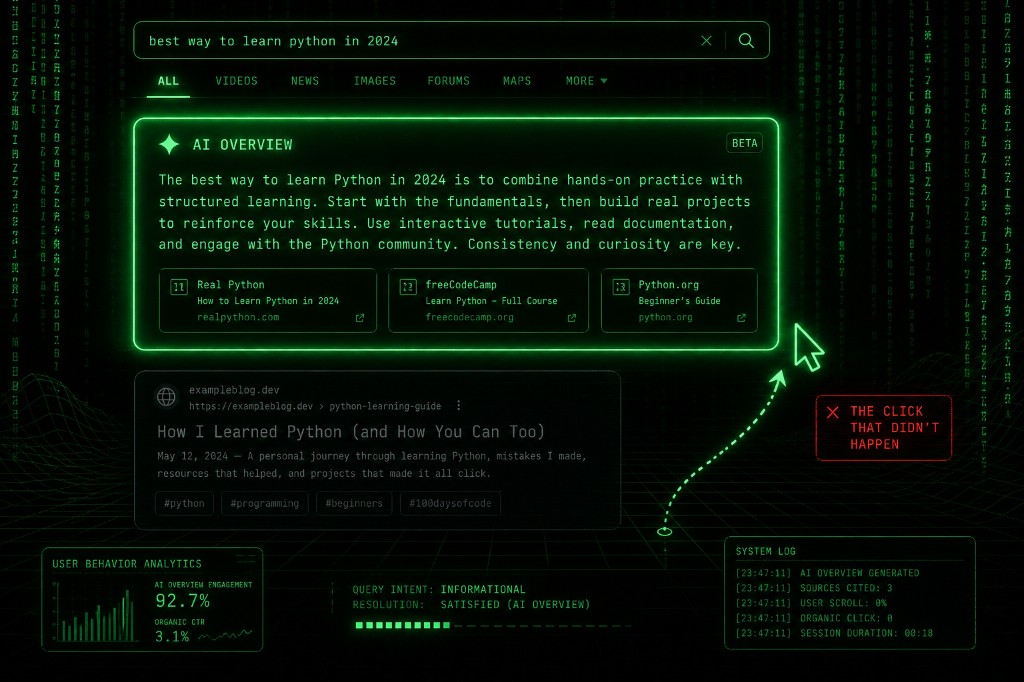
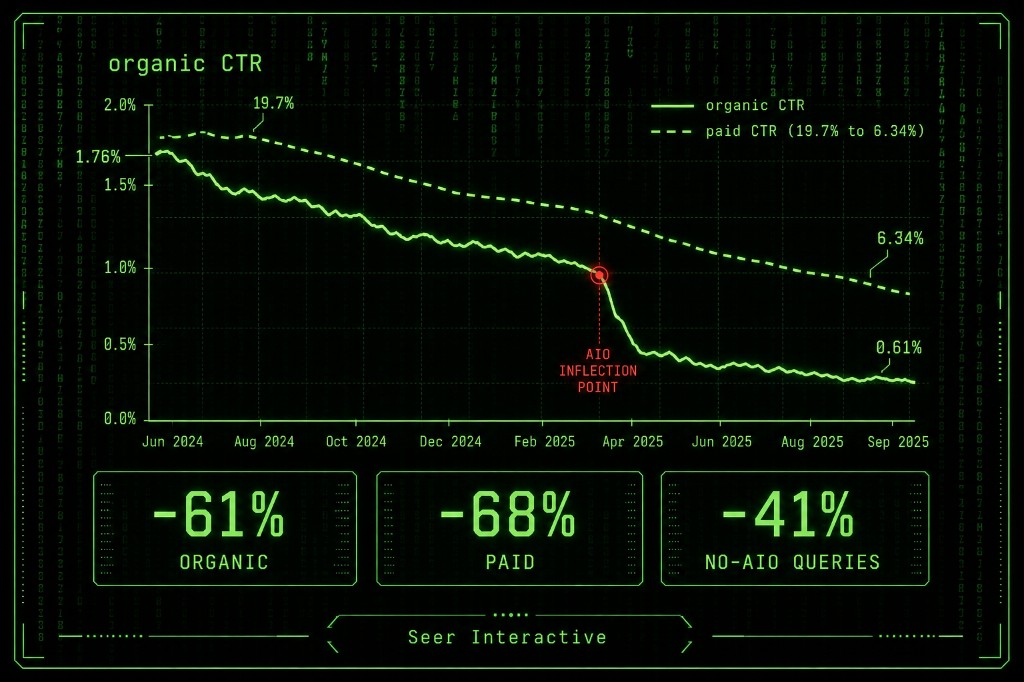
It's 2am. You opened Search Console because organic traffic is down 40% over six months. Manual Actions: clean. Security Issues: clean. You google "Google penalty checker" and get nothing. Your impressions might even be flat or up. Only the clicks are gone. You weren't penalized. Google now answers your visitor's question in an AI Overview block above your link, and the click never happens. Seer Interactive measured the collapse: 61% drop in organic CTR on AIO queries — from 1.76% to 0.61%. Pages CITED inside the AI Overview earn +35% organic clicks. The math is brutal but it's not random. Here's exactly what changed, the 7-move playbook to claim the citation seat, and the channels you need to grow alongside Google because the absolute click pool is shrinking either way.
Were You Actually Penalized?
Almost certainly no. Penalties surface in Search Console under Manual Actions or Security Issues. If both are clean, the drop isn't a penalty — it's the new SERP. AI Overviews appear on 25.8% of US searches as of January 2026, and on 39.4% of informational queries (Stackmatix). The fingerprint is the impression-to-click ratio: impressions roughly steady, clicks halved. That ratio collapse is AIO eating the click. Penalty diagnostic checks won't catch it because nothing was punished — Google just stopped sending the visitor.
Pew Research's March 2025 panel of 900 US adults found users clicked a result link 8% of the time when AIO was present versus 15% without — a 47% relative drop. AIO source citations themselves were clicked just 1% of the time (Pew). And 26% of users ended their browsing session entirely after seeing an AIO, up from 16% on traditional SERPs. The Matrix* changed the rules. Your site didn't break — the SERP did.
What Does the New Math Actually Look Like?
Three numbers explain everything. Coverage: 25.8% of US searches in January 2026, up 58% year-over-year (Emarketed). CTR collapse: 61% organic, 68% paid (Seer, 3,119 search terms across 42 client orgs, June 2024–Sept 2025). Citation seat: +35% organic clicks and +91% paid clicks for brands cited INSIDE the AIO compared to non-cited brands on the same query.
The publisher casualty list reads like a forensic ledger. Mashable -30%. Wired -62%. ZDNet, The Verge, HowToGeek each over -85%. Digital Trends collapsed from 8.5M monthly clicks (March 2024) to 264,861 (January 2026) — a 97% wipeout (Growtika, Nieman Lab). HubSpot lost 70–80% of organic between November 2024 and Q2 2025. Tech publications collectively lost 58% of Google traffic since 2024. This is not a bug. It is the equilibrium.
The reframe: you either get cited or you lose roughly 61%. There is no third option where things stay the same.
Why Isn't Your Content Being Cited?
Because AIO doesn't extract from beautifully-written essays. It extracts from question-shaped H2s with answer-first 40–60-word paragraphs, dense with sourced statistics and named-expert quotations. Your post may be excellent — and entirely unextractable. Quality is the entry ticket: 97% of AIO citations come from pages already ranking in the top 20 organic results. But ranking is no longer the lever. Extractability is.
Compare a typical SMB blog opener — "In this article, we'll explore the various reasons why your website traffic might be declining and discuss several actionable strategies you can implement…" — with the answer-first version: "Your traffic is dropping because AI Overviews now appear on 25.8% of US searches, and CTR on those queries fell 61%. Here's how to claim the citation seat." Same topic. Only the second one gets quoted.
The four extraction blockers we see most often on client sites: paragraphs longer than four lines, no embedded statistics, no named-expert quotations, and H2s written as headlines instead of questions. Fix those four and you're in the running. Skip them and you're invisible to the model regardless of how thoughtful the prose is.
What's the 7-Move Playbook to Get Cited?
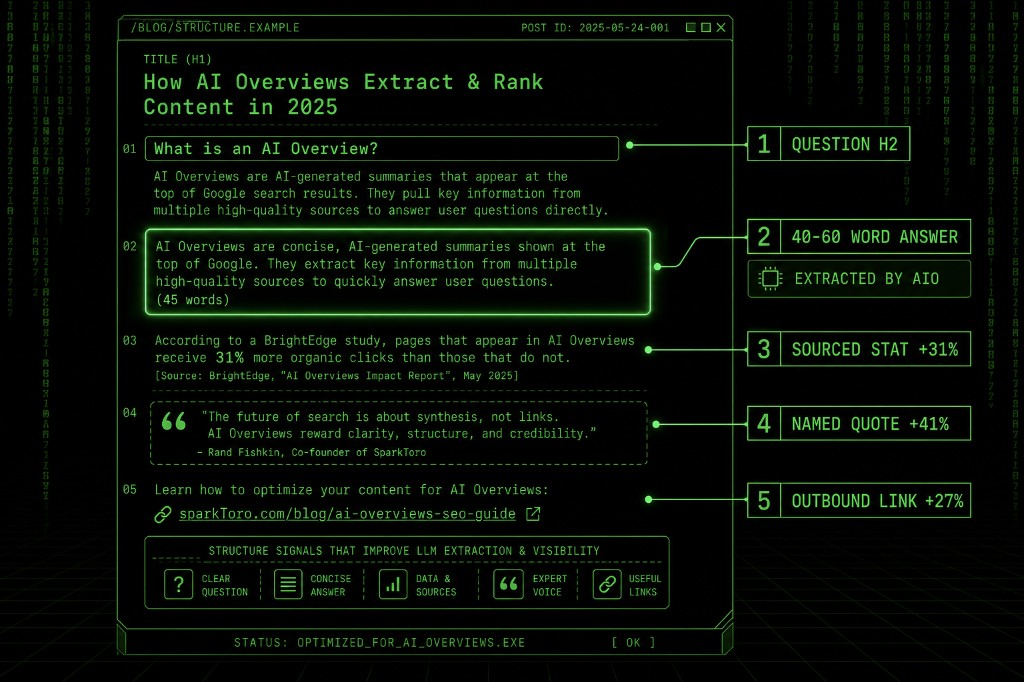
Each move maps to a citation lift measured by Princeton's GEO study (Aggarwal et al., KDD 2024 — 10,000 queries, 9 tactics tested) or Seer Interactive's data. Apply all seven to one post in an afternoon. You'll see citation pickup over 4–8 weeks if the page already ranks top-20.
- Rewrite every H2 as a question. "Pricing tiers explained" becomes "How much does X cost?" The model uses H2 question-shape as a primary extraction signal.
- First 40–60 words below each H2 = the direct answer. Period. No "in this section we'll cover" preamble. AIO extracts that opening block almost verbatim.
- Cap paragraphs at 4 lines. Bullet anything multi-part. Long narrative paragraphs are harder to quote cleanly and get skipped.
- Embed one sourced statistic every 150–200 words. "61% drop in CTR (Seer, Sept 2025)" gets quoted. "Significant decline in click-through" gets ignored. Statistics Addition lifted citation +31% in Princeton's study.
- Add one named-expert quotation per major section. Princeton: Quotation Addition lifted citation +41%. Quotation marks plus named attribution functions as a credibility proxy the model reads.
- Cite outward. 1–2 authoritative outbound links per major H2. Cite Sources lifted +27%. Almost all AIO-cited pages link OUT to trusted domains — citation creates a chain of trust the model recognizes.
- Add FAQPage schema with question-shaped H2s mirroring AIO answer format. Correlates with +20% citation probability on top of strong content. Schema is an amplifier, not a foundation — without answer-first H2s underneath, schema alone does nothing (Search Engine Land, Dec 2024).
Demonstrate while you teach: this post is structured against all seven moves. Question-shaped H2s. Answer-first openers. Sourced stats every 150 words. Quotation. Outbound links. FAQ section below. That's the bar.
Even If You Get Cited, Won't the Click Pool Still Shrink?
Yes, and that's the second half of the math. Zero-click searches climbed from 56% pre-AIO to 69% post-AIO; mobile zero-click hit 77% (Click-Vision). Citation gets you the bigger slice of a smaller pie. Diversification is no longer optional — it's the only way the revenue floor stays intact across the next algorithm cycle.
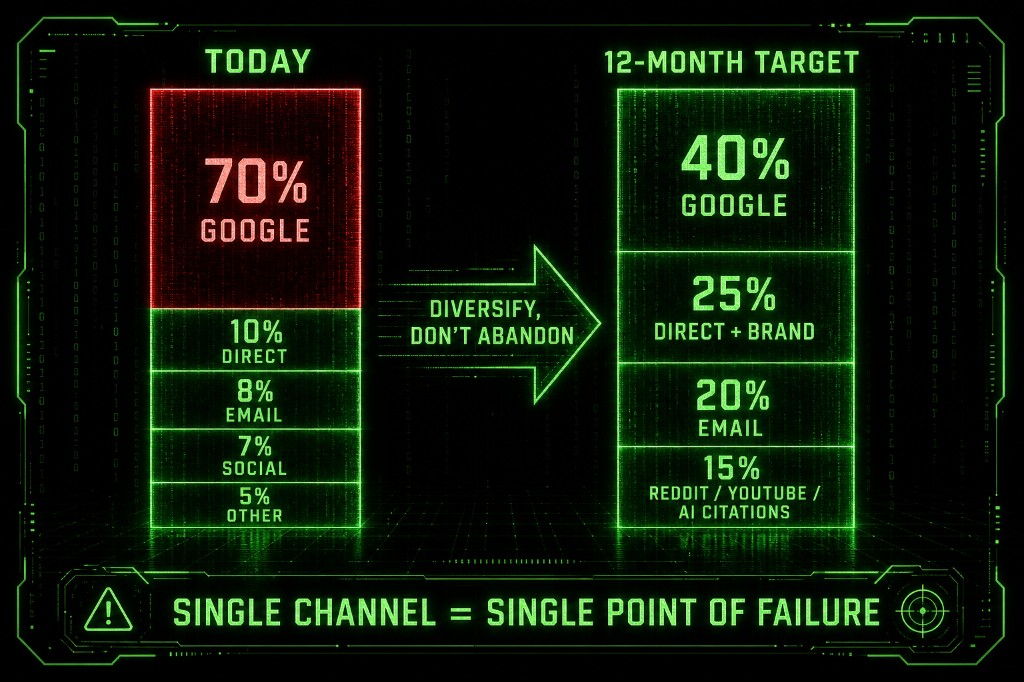
Four channels worth growing now. Owned email list — Google can't take this from you. Direct and brand search — when someone types your business name, AIO can't intercept it. Reddit and YouTube — Semrush's billions-of-visits study found Reddit and YouTube combined account for 78.2% of AI social citations (Reddit 46.4%, YouTube 31.8%) (Semrush). Generative-engine optimization across ChatGPT, Perplexity, and Gemini, treated as a portfolio rather than a single channel.
A workable 12-month target for an SMB currently at 70% Google traffic: drop to 40% Google, grow direct + brand to 25%, email to 20%, Reddit/YouTube/AI-citation to 15%. That portfolio survives the next AIO update. A single-channel dependency does not.
How Do You Measure Any of This?
Stop chasing ranking position alone. Position can stay flat while clicks halve — the metric you used for fifteen years no longer correlates with revenue. The dashboard has to pivot. Five things to track instead:
- AIO-presence on your top 50 keywords. Manual SERP scrape, or a tracker like Otterly, Peec, or AIOSEO's AIO module. Knowing WHICH queries trigger AIO tells you which pages need the playbook applied first.
- Citation share. When AIO appears on your target query, are you in the citation list — or just the blue link below? These are now two different games.
- GSC impression-to-click ratio per query. A collapsing ratio is the AIO fingerprint. Impressions hold or grow; clicks drop. That's the diagnosis.
- Direct + brand-search volume. Both available in GSC. They're the proxy for owned-audience health — and they're un-disintermediable.
- Email list size × open rate. The Google-proof revenue floor. Track it monthly. Grow it deliberately.
The Operators*' shorthand: if your impressions are up and your clicks are down, you don't need an SEO audit. You need a citation audit.
What Do ProWebCare's Operators* Actually Do About This?
Three concrete steps, applied to your existing inventory — not a six-month content overhaul. (1) Audit which of your top-30 ranking posts now trigger an AIO on their target query, and whether you're cited or excluded. (2) Restructure the highest-priority posts using the 7-move playbook — usually 30–60 minutes per post — and inject FAQPage schema where it earns its place. Re-submit each to Search Console. (3) Watch citation pickup over 30, 60, and 90 days. Iterate the misses. Double down on the wins.
This is a maintenance retainer task, the same lens we use for patching plugins or watching supply-chain backdoors. The playbook is repeatable. The portfolio of WordPress and Joomla sites we maintain gives us a citation-pickup signal across verticals — what works for a SaaS blog versus a local-service site versus an e-commerce category page. We're not theorizing about AIO. We're measuring it on real client traffic.
Frequently Asked Questions
Almost certainly no. Penalty signals show up in Search Console under Manual Actions or Security Issues — if those are clean, the drop isn't a penalty. The far more likely cause: AI Overviews now appear on 25.8% of US searches (39.4% on informational queries), and they answer the user above your link. Your impressions may even be flat or up while clicks halve. That ratio collapse is the fingerprint, not a penalty.
Depends on the query mix. Seer Interactive measured a 61% organic CTR drop on AIO-triggering queries. Tech publishers got hit hardest — Wired -62%, ZDNet over -85%, Digital Trends -97%. SMB sites in service categories (legal, medical, B2B) typically see -20% to -50% in the first 12 months after AIO expansion into their vertical. If you're past 60% loss, your content is also losing rank, not just clicks.
Partially. Seer Interactive found brands CITED inside AIO earn 35% more organic clicks and 91% more paid clicks than non-cited brands on the same query. So citation matters — a lot. But absolute click volume is still down because the underlying pool shrunk: zero-click searches went from 56% pre-AIO to 69% post. Citation gets you the bigger slice of a smaller pie.
Three moves with the highest ROI per Princeton's GEO study and Seer's data: rewrite every H2 as a question and put a direct 40–60-word answer in the paragraph below it; add one sourced statistic every 150–200 words (lifts citation ~31%); add one named-expert quotation per major section (lifts ~41%). Most pages need 30–60 minutes per post to do all three. Citation pickup follows over 4–8 weeks if your page already ranks top-20.
Yes, but it's an amplifier, not a foundation. FAQPage schema correlates with about 20% higher citation probability when the underlying content is already answer-first and authoritative. Without question-shaped H2s and 40–60-word answers, schema alone does nothing — a December 2024 study found no correlation between schema coverage and citations on weak content. Schema works when the content underneath it works.
No — diversify, don't abandon. Google still sends meaningful traffic; you just need a portfolio. A reasonable 12-month target for an SMB currently at 70% Google traffic: drop to 40% Google, grow direct + brand search to 25%, email to 20%, Reddit/YouTube/AI-citations to 15%. This survives any single algorithm shift. Putting 100% of growth into email is the same mistake as putting 100% into Google was — just one cycle later.
Why Your Maintenance Retainer Should Cover the Citation Seat
The 7-move playbook isn't hard. It's just relentless. Twenty top-traffic posts × 45 minutes per restructure = roughly 15 hours of focused operator work, plus citation tracking on a 30/60/90 cadence after that. Most owners can't carve that out alongside running the business.
Our maintenance plans treat AIO citation as a recurring task, not a one-time project — the same lens we apply to plugin patches and uptime watch. Audit, restructure, schema, track, iterate. If your impressions are up and your clicks are down, that's the signal. Maintenance plans here.
If you'd rather start with a single audit — which posts trigger AIO, are you cited, what the restructure backlog looks like — our SEO audit covers exactly that. Real Life* is for your customers. The Matrix* citation fight is what we do.