🚨 Google just did for commerce what HTTP did for the web.
It's called Universal Commerce Protocol (UCP), and it's a new open standard for AI agent-driven purchases. This isn't theory. It's reality. And it changes everything about how shopping works.
For 20 years, commerce followed the same flow: Search → Ads → Product Pages → Checkout. UCP breaks that completely. The new model becomes: Intention → AI Agent Reasoning → Purchase. No clicks. No funnels. Just autonomous software handling the entire journey.
UCP launched with major industry backing: Shopify, Walmart, Target, Etsy, Wayfair, Visa, Stripe, Adyen. Over 20 partners from day one. This is how standards are born.
As businesses adapt to this new commerce infrastructure, understanding how website development and SEO optimization work in an AI agent-driven world becomes critical. The rules are changing.
What Is Universal Commerce Protocol?
Universal Commerce Protocol (UCP) is an open standard that creates a common language for AI agents, merchants, and payment systems to transact autonomously, end-to-end.
Think of it like HTTP for commerce. Just as HTTP standardized how web browsers communicate with servers, UCP standardizes how AI agents communicate with commerce systems. It's the infrastructure layer that makes AI agent commerce possible.
UCP enables AI agents to:
- Discover merchant capabilities automatically
- Compare products, prices, and features across platforms
- Negotiate prices, packages, loyalty programs, and subscriptions
- Execute secure payments
- Manage post-purchase support, returns, and exchanges
All without custom integrations. All through a single protocol.
This eliminates the classic N×N integration problem that has blocked e-commerce for decades. Instead of every merchant building custom integrations with every AI agent, everyone uses UCP. One protocol. Universal compatibility.
For businesses building or maintaining e-commerce platforms, this shift requires rethinking traditional website development approaches. The focus moves from user interfaces to protocol compatibility.
How UCP Transforms Commerce: From Clicks to AI Agents
The traditional commerce model is broken. Here's why:
The Old Model (20 Years):
- User searches for product
- Clicks on ads or product pages
- Navigates through multiple pages
- Fills out checkout forms
- Completes payment
- Manages returns/support manually
The New Model (UCP):
- User expresses intention ("I need a new laptop")
- AI agent reasons: researches options, compares features, checks prices
- AI agent negotiates: finds best deals, applies loyalty programs
- AI agent purchases: completes transaction autonomously
- AI agent manages: handles returns, support, subscriptions
Zero clicks. Zero manual work. Complete autonomy.
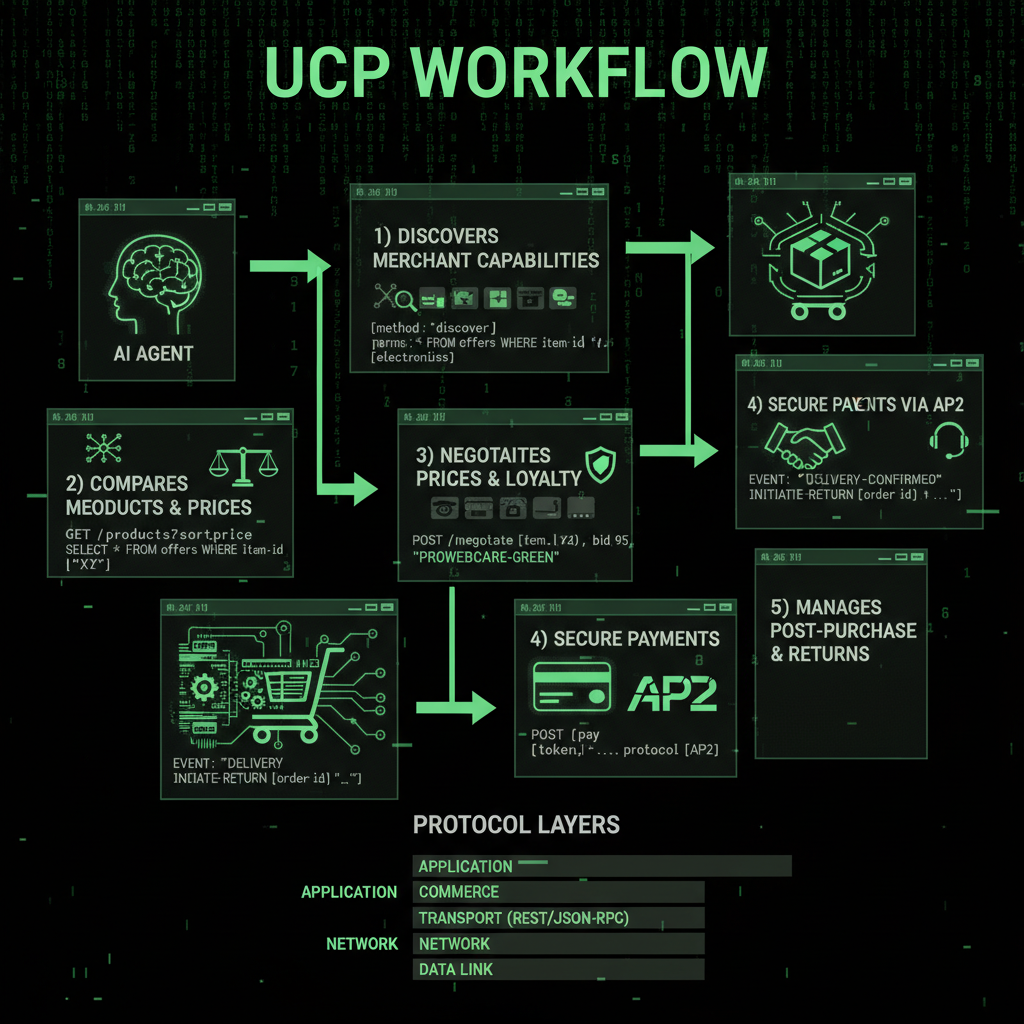
What This Means for Shopping
UCP transforms shopping from a manual process to an autonomous one. Instead of you clicking through websites, AI agents do the work:
- Discovery: Agents automatically find products that match your needs across all merchants
- Comparison: Agents compare prices, features, reviews, and availability in real-time
- Negotiation: Agents negotiate discounts, apply loyalty points, find bundle deals
- Purchase: Agents complete transactions securely without your intervention
- Post-Purchase: Agents handle returns, exchanges, and customer support
You express what you want. The agent handles everything else.
The End of Traditional E-Commerce Funnels
Traditional e-commerce relies on funnels: awareness → interest → consideration → purchase. UCP eliminates funnels entirely.
There's no funnel when an AI agent can discover, compare, negotiate, and purchase in seconds. The entire journey happens autonomously. Brands don't compete for clicks. They compete for agent selection.
This fundamental shift means traditional SEO strategies need to evolve. Instead of optimizing for human search behavior, businesses must optimize for AI agent discovery and selection.
The Technical Foundation: How UCP Works
UCP is built on industry standards: REST and JSON-RPC. It's designed to be open, flexible, and scalable.
Core Components:
- A2A (Agent-to-Agent): Agents communicate with other agents
- MCP (Model Context Protocol): Shared context between systems
- AP2 (Agent Payment Protocol): Cryptographically signed payment mandates
UCP connects these components into a unified commerce infrastructure. It's the "glue" that makes AI agent commerce work.
Why UCP Doesn't Replace Existing Infrastructure
UCP doesn't replace your existing e-commerce platform. It connects it.
- Merchants remain merchant-of-record
- Users keep freedom of choice
- Agents do the work
UCP is infrastructure, not a platform. It's the protocol that enables interoperability, not a walled garden.
For businesses maintaining existing platforms, this means UCP can integrate with your current website maintenance infrastructure without requiring a complete rebuild. The protocol connects, it doesn't replace.
Payment Processing with UCP
UCP integrates with existing payment systems: Visa, Stripe, Adyen, and others. The protocol handles secure payment execution through AP2 (Agent Payment Protocol), which uses cryptographically signed mandates.
This means payments are secure, verifiable, and autonomous. The agent can complete transactions without manual approval for each purchase, while maintaining security through cryptographic signatures.
Industry Adoption: Who's Backing UCP
UCP launched with major industry support. This isn't a Google-only initiative. It's an industry standard backed by:
Retail Platforms:
- Shopify
- Walmart
- Target
- Etsy
- Wayfair
Payment Processors:
- Visa
- Stripe
- Adyen
Total Partners: Over 20 organizations from day one.
This level of adoption on launch day is how standards are born. When major players across retail, payments, and technology all support a protocol, it becomes infrastructure.
Why Major Players Are Adopting UCP
Major companies are backing UCP because it solves real problems:
- Reduces Integration Costs: One protocol instead of N×N integrations
- Enables AI Commerce: Makes autonomous shopping possible
- Future-Proofs Infrastructure: Prepares for AI agent commerce
- Creates Network Effects: More adoption = more value
It's not just about technology. It's about positioning for the future of commerce.
Businesses that understand these shifts early can position themselves for success. Whether you're running an e-commerce platform or managing website development projects, UCP represents a fundamental change in how commerce works.
Google's Strategic Position
Google is uniquely positioned to lead UCP because it already owns the key assets:
- Global Intent Data: Google Search captures billions of shopping intentions daily
- Product Graph: The world's largest database of products and relationships
- AI Models: Gemini integrated across Search, Android, YouTube
- Distribution: Search, Android, YouTube reach billions of users
UCP transforms these assets into open infrastructure, not a walled garden. Google doesn't lock merchants in. It connects them.
This is strategic. Commerce is about matching intention with offer, at scale. Google owns intention. UCP connects it to offers. The result: infrastructure that benefits everyone while positioning Google at the center.
Why Open Standards Matter
UCP is open, not proprietary. This matters because:
- Merchants stay independent: They remain merchant-of-record
- Users keep choice: They can use any agent or platform
- Innovation flourishes: Anyone can build on UCP
- Network effects grow: More participants = more value
Open standards win. HTTP won because it was open. UCP can win for the same reason.
For businesses, this openness means you're not locked into a single platform. You can build on UCP while maintaining your existing maintenance plans and infrastructure. The protocol connects everything.
The Future of Commerce: Autonomous and Everywhere
UCP marks the beginning of non-human commerce. Here's what changes:
Brands compete for agent selection, not human attention.
Traditional marketing focuses on capturing human attention. With UCP, brands need to optimize for AI agent selection. Agents choose products based on:
- Price competitiveness
- Product quality and reviews
- Availability and shipping speed
- Return policies
- Loyalty program value
Human attention becomes less important. Agent optimization becomes critical.
Websites become optional.
If AI agents can discover products through UCP without visiting websites, traditional e-commerce sites become less critical. The protocol becomes the interface. The website becomes a fallback, not the primary channel.
This doesn't mean website development becomes irrelevant—it means the focus shifts. Websites need to work for both humans and agents, with protocol compatibility becoming as important as user experience.
Checkout buttons become legacy.
When agents handle purchases autonomously, traditional checkout flows become obsolete. The button that defined e-commerce for 20 years becomes a legacy interface. The protocol handles transactions. No button needed.
Loyalty shifts from humans to agents.
Customer loyalty programs designed for humans need to adapt for agents. Agents optimize for value, not emotion. Loyalty programs that work for agents will win. Programs designed only for humans will lose.
The Quiet Revolution
This is the beginning of commerce that's:
- Quiet: Happens in the background, autonomously
- Autonomous: No human clicks or decisions required
- Everywhere: Integrated into daily life seamlessly
You won't notice it happening. It just works. That's the point.
What This Means for Your Business
If you run an e-commerce business, UCP changes how you compete:
- Optimize for agents, not just humans: Make your products discoverable and attractive to AI agents
- Focus on value, not clicks: Agents optimize for price, quality, and service, not clickbait
- Prepare for autonomous commerce: Your infrastructure needs to support UCP
- Rethink loyalty programs: Design programs that work for both humans and agents
Early adopters will have advantages. Understanding UCP now positions you for the future. Whether you're planning new website development projects or optimizing existing platforms with SEO audits, UCP compatibility should be part of your strategy.
Frequently Asked Questions
What is Universal Commerce Protocol?
Universal Commerce Protocol (UCP) is an open standard that enables AI agents, merchants, and payment systems to transact autonomously. It's like HTTP for commerce—a protocol that standardizes how systems communicate for shopping transactions.
How does UCP work?
UCP uses REST and JSON-RPC to enable AI agents to discover products, compare options, negotiate prices, execute payments, and manage post-purchase support. The protocol connects agents, merchants, and payment systems through standardized APIs.
What companies are using UCP?
UCP launched with support from Shopify, Walmart, Target, Etsy, Wayfair, Visa, Stripe, Adyen, and over 20 other partners. Major retail and payment companies are adopting UCP to enable AI agent commerce.
How does UCP compare to traditional e-commerce?
Traditional e-commerce requires users to search, click, navigate, and checkout manually. UCP enables AI agents to handle the entire shopping journey autonomously—from discovery to post-purchase support—without user clicks or manual intervention.
What does UCP mean for small businesses?
UCP levels the playing field by providing a standard protocol that any merchant can adopt. Small businesses can participate in AI agent commerce without building custom integrations, making autonomous shopping accessible to businesses of all sizes. With proper website development and maintenance plans, small businesses can compete in the AI agent commerce era.
Is UCP replacing websites?
UCP doesn't replace websites, but it makes them less critical. AI agents can discover and purchase products through UCP without visiting websites. Websites become a fallback option rather than the primary commerce channel.
How does UCP affect payment processing?
UCP integrates with existing payment systems (Visa, Stripe, Adyen) through AP2 (Agent Payment Protocol), which uses cryptographically signed payment mandates. This enables secure, autonomous payment processing without manual approval for each transaction.
Conclusion
Google's Universal Commerce Protocol is doing for commerce what HTTP did for the web. It's creating a universal standard that enables AI agents to autonomously handle the entire shopping journey.
This isn't theory. It's reality. UCP launched with major industry backing and is already changing how commerce works. The shift from clicks to autonomous agents is happening now.
For businesses, this means optimizing for agent selection, not just human attention. For consumers, this means shopping becomes seamless and autonomous. For the industry, this means a new standard that connects everyone.
UCP is the beginning of non-human commerce: quiet, autonomous, everywhere. The future of shopping isn't about websites or checkout buttons. It's about protocols that make commerce work seamlessly in the background.
That future is here. UCP makes it possible.